-
Koszyk jest pusty
-
x

-
Koszyk jest pusty
-
x
-
-
-
Koszyk jest pusty
-
x
Do bezpłatnej dostawy brakuje -,--Darmowa dostawa!Suma 0,00 złCena uwzględnia rabaty -
- Kategorie
-
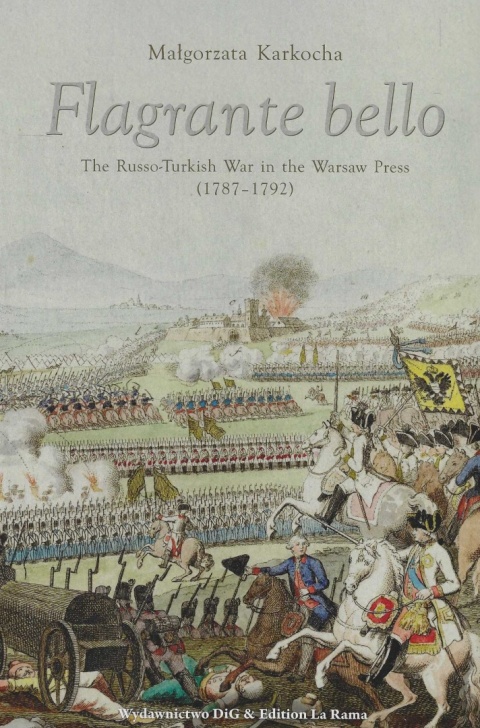
Flagrante bello. The Russo-Turkish War in the Warsaw Press (1787 - 1792)
| Wysyłka w ciągu | 24 godziny |
| Cena przesyłki | 11 |
| Dostępność |
Mała ilość
|
| Kod kreskowy | |
| ISBN | 9788328602922 |
| EAN | 9788328602922 |
| Zostaw telefon |
Autorka: Małgorzata Karkocha
Rok wydania: 2025
Liczba stron: 300
Okładka: twarda
Format: 17,0 cm x 24,0 cm
UWAGA! Książka w j. angielskim
FLAGRANTE BELLO, Abstract:
The book Flagrante bello. The Russo-Turkish War in the Warsaw Press (1787–1792) by Małgorzata Karkocha constitutes the first comprehensive attempt to reconstruct the image of the Russo-Turkish War of 1787–1792 as presented in Polish-language Warsaw periodicals during the reign of King Stanisław August Poniatowski. The author addresses both the factual course of the conflict and the mechanisms of press reporting, including its sources, delays in information transmission, and the political and ideological determinants shaping editorial narratives. The study is based primarily on four Warsaw newspapers: Gazeta Warszawska, Pamiętnik Historyczno-Polityczno-Ekonomiczny, Gazeta Narodowa i Obca, and Korespondent Warszawski. Karkocha demonstrates that, despite the absence of permanent war correspondents, the Warsaw press provided readers with extensive and relatively systematic information on military operations, diplomacy, and the broader international context of the conflict. This coverage relied chiefly on foreign French-, German-, and English-language newspapers, as well as on private and diplomatic correspondence. The book follows a chronological and thematic structure. Subsequent chapters examine the course of the war year by year—from the opening campaign of 1787, through the intensive military operations of 1788–1790, to the peace negotiations culminating in the Treaty of Jassy in 1792. Particular attention is devoted to major military events, including the sieges of Ochakov and Izmail, the battles of Focsani and Rymnik, the capture of Belgrade, and naval operations in the Black Sea. The analysis highlights how these events were reported in the Warsaw press, noting differences in detail, emphasis, and temporal delay. A central theme of the book is the issue of editorial bias and commentary. The author identifies clear differences in the attitudes of individual newspapers toward the so-called Eastern Question: from the consistently pro-Russian stance of Gazeta Warszawska edited by Stefan Łuskina, through the more pro-Turkish and pragmatic perspective of Pamiętnik under Piotr Świtkowski, to the patriotic and reform-oriented outlook of Gazeta Narodowa i Obca. As a result, the Warsaw press emerges not merely as a neutral conveyor of information, but as an active participant in contemporary political debate, shaping public opinion. By confronting press reports with memoirs, diplomatic correspondence, official documents, and modern historiography, the author reveals both the accuracy and the limitations of eighteenth-century newspaper accounts, including their simplifications and propagandistic elements. The book thus presents the Warsaw press as a valuable yet critically demanding source for the study of the Russo-Turkish War and the political culture of the late Enlightenment. The study makes a significant contribution to research on the history of the press, political communication in the Enlightenment, and the reception of international events in the Polish–Lithuanian Commonwealth on the eve of its collapse. It also constitutes an important supplement to the historiography of the so-called Great Eastern War.
Keywords:
Russo-Turkish War (1787–1792); Warsaw press; eighteenth-century newspapers; political communication; Eastern Question; Enlightenment press; Stanisław August Poniatowski; public opinion; military reporting; diplomacy; Polish–Lithuanian Commonwealth
Książka "Flagrante bello. The Russo-Turkish War in the Warsaw Press (1787–1792)" autorstwa Małgorzaty Karkochy stanowi pierwszą kompleksową próbę rekonstrukcji obrazu wojny rosyjsko-tureckiej lat 1787–1792 w polskojęzycznej prasie warszawskiej doby panowania Stanisława Augusta Poniatowskiego. Autorka podejmuje zarówno analizę faktograficzną przebiegu konfliktu, jak i badanie mechanizmów przekazu prasowego, jego źródeł, opóźnień informacyjnych oraz uwarunkowań politycznych i ideowych redakcji.
Podstawą źródłową pracy są cztery główne tytuły prasowe ukazujące się w Warszawie: Gazeta Warszawska, Pamiętnik Historyczno-Polityczno-Ekonomiczny, Gazeta Narodowa i Obca oraz Korespondent Warszawski. Autorka pokazuje, że prasa ta, mimo braku własnych korespondentów wojennych, dostarczała czytelnikom szerokiej i stosunkowo systematycznej informacji o działaniach militarnych, dyplomacji oraz kontekście międzynarodowym konfliktu, korzystając głównie z zagranicznych gazet francuskich, niemieckich i angielskich oraz z korespondencji prywatnej i dyplomatycznej.
Praca ma układ chronologiczno-problemowy. Kolejne rozdziały omawiają przebieg wojny rok po roku – od kampanii 1787, przez intensywne działania lat 1788–1790, aż po negocjacje pokojowe i traktat w Jassach z 1792 r. Szczególną uwagę poświęcono kluczowym wydarzeniom militarnym, takim jak oblężenia Oczakowa i Izmaiłu, bitwy pod Fokszanami i Rymnikiem, upadek Belgradu oraz operacje morskie na Morzu Czarnym. Analiza pokazuje, jak wydarzenia te były relacjonowane w prasie, z jakimi opóźnieniami i z jakim stopniem szczegółowości.
Istotnym wątkiem książki jest problem stronniczości i komentarza redakcyjnego. Autorka wykazuje wyraźne różnice w podejściu poszczególnych redakcji do tzw. kwestii wschodniej: od konsekwentnie prorosyjskiej narracji Gazety Warszawskiej Stefana Łuskiny, przez bardziej proturecką i realistyczną ocenę sytuacji w Pamiętniku Piotra Świtkowskiego, po patriotyczno-reformatorską perspektywę Gazety Narodowej i Obcej. Prasa nie była zatem jedynie neutralnym medium informacyjnym, lecz aktywnym uczestnikiem debaty politycznej, kształtującym opinie czytelników.
Autorka konfrontuje doniesienia prasowe z pamiętnikami, korespondencją, aktami dyplomatycznymi oraz nowożytną historiografią, wskazując zarówno na trafność wielu ówczesnych relacji, jak i na ich ograniczenia, uproszczenia czy propagandowy charakter. W rezultacie książka ukazuje prasę warszawską jako cenne, choć wymagające krytycznej lektury źródło do dziejów wojny rosyjsko-tureckiej i kultury politycznej schyłku XVIII wieku.
Praca wnosi istotny wkład do badań nad historią prasy, komunikacją polityczną epoki oświecenia oraz recepcją wydarzeń międzynarodowych w Rzeczypospolitej u progu jej upadku, stanowiąc jednocześnie ważne uzupełnienie historiografii tzw. wielkiej wojny wschodniej.
(opis wydawcy)
Table od Contents:
List of abbreviations /7
List of illustrations and maps /8
Introduction /11
1. Review of sources /11
2. The Warsaw press /14
Methods of sourcing newspaper content /16
Editorial commentary /22
The Russo-Turkish war in the Warsaw press /26
The editorial approach to the Eastern Question /27
3. Notes and acknowledgments /32
Chapter I. 1787: the first campaign /35
The beginning of the war /35
Operations in the Dnieper Liman region and the Kuban /47
Attempts at mediation /53
Chapter II. Military operations of 1788 /57
Austria’s entry into the war /57
Naval engagements /68
The summer and autumn campaign /74
The siege of Ochakov /89
Chapter III. The campaign of 1789 /100
War or peace? /100
The first skirmishes and clashes /107
Focsani /112
The Battle of Rymnik /116
The fall of Belgrade /121
Further advances of the allies in Serbia and Wallachia /127
Naval operations /133
Chapter IV. The year 1790 /135
Peace negotiations. The Prusso-Ottoman military alliance /135
Military preparations /141
The Reichenbach convention. Armistice between Austria and Turkey /146
Attempts to impose the status quo on Russia /154
The Austrian campaign /156
The Russian campaign /161
Izmail /169
Chapter V. The last year of the war /178
Negotiations in Sistova. Peace between Austria and Turkey /178
The Ochakov crisis /194
The defeats of the Turkish army and navy / 204
The Peace of Jassy /210
Conclusion /220
Appendices /225
Bibliography / 253
Résumé /274
Index of geographical names /277
Index of personal names /284
Dane producenta
Wydawnictwo DiG Sp.j.
ul. Dankowicka 16C lok. 2
01-987 Warszawa
Poland
biuro@dig.pl